

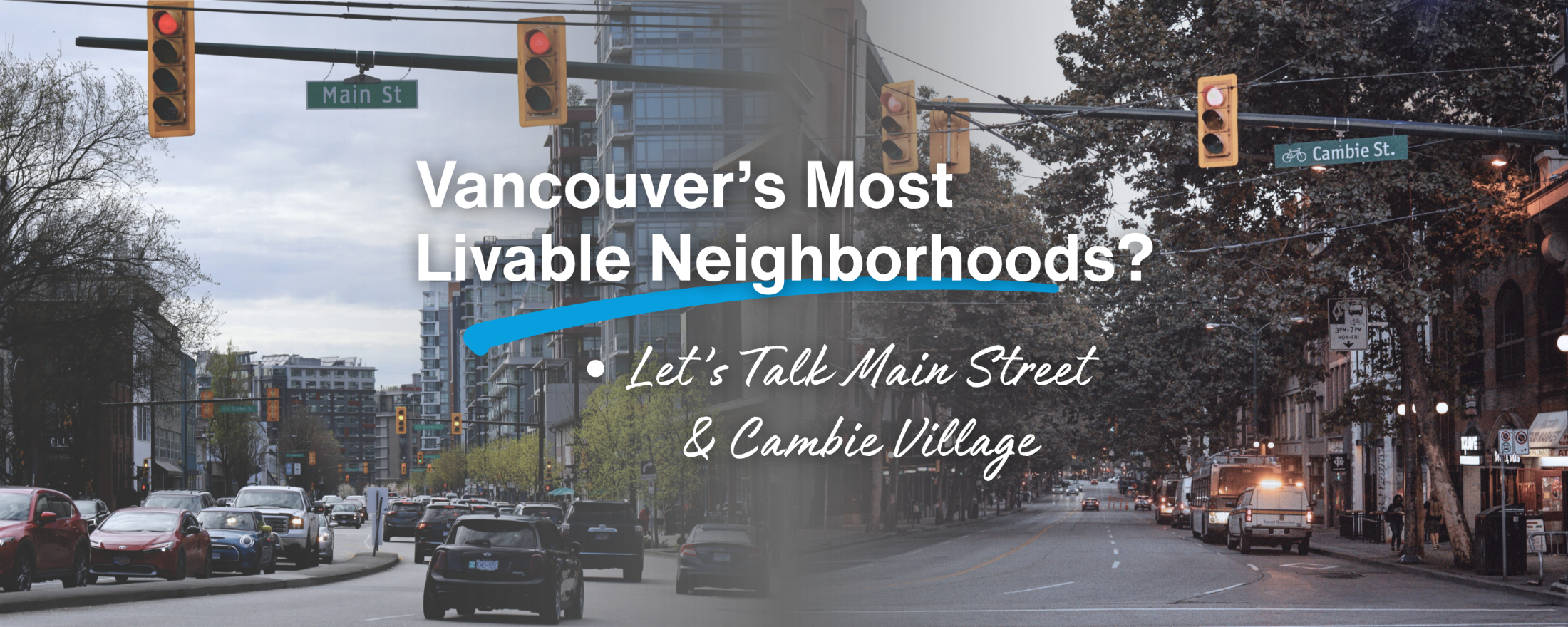
The Vancouver real estate market has shifted noticeably in 2026. Prices have softened, buyers have become more selective, and homes are generally taking longer to sell. But one thing hasn't changed: location remains one of the most important factors in real estate.
With Greater Vancouver detached home prices down 7% over the past year, townhomes down 5.5% and apartments down 5.9%, it's worth looking beyond the headlines to understand what makes certain neighbourhoods attractive to buyers.
Main Street and Cambie Village are two excellent examples, along with surrounding communities such as Fraser Street, Riley Park and Mount Pleasant.
These neighbourhoods combine established residential streets, independent businesses, parks, schools, transportation, and a diverse housing selection.
Our real estate office is located at Main Street and 32nd Avenue, and I live in the Lower Cambie area. I've also recently sold three properties around Fraser Street. I know these neighbourhoods well, both personally and professionally.
While no neighbourhood is immune to a market correction, understanding the location, property type, and recent comparable sales is more important than ever.
Vancouver Real Estate Market Update: October 2026
The latest statistics from Greater Vancouver REALTORS® confirm that the market remains under pressure.
Metro Vancouver recorded 2,024 residential sales in October 2026, down 10.2% compared with October 2025 and 22.5% below the 10-year seasonal average.
There were also 15,688 properties listed for sale across the region, approximately 24% above the 10-year seasonal average.
For buyers, this generally means more choice and greater opportunity to negotiate. For sellers, it reinforces the importance of accurate pricing, presentation, and understanding the competition.
But the most interesting numbers are the changes in property values.
How Much Have Vancouver Property Values Changed?
The following figures are from the October 2026 Greater Vancouver REALTORS® MLS® Home Price Index, comparing benchmark property values across Greater Vancouver.
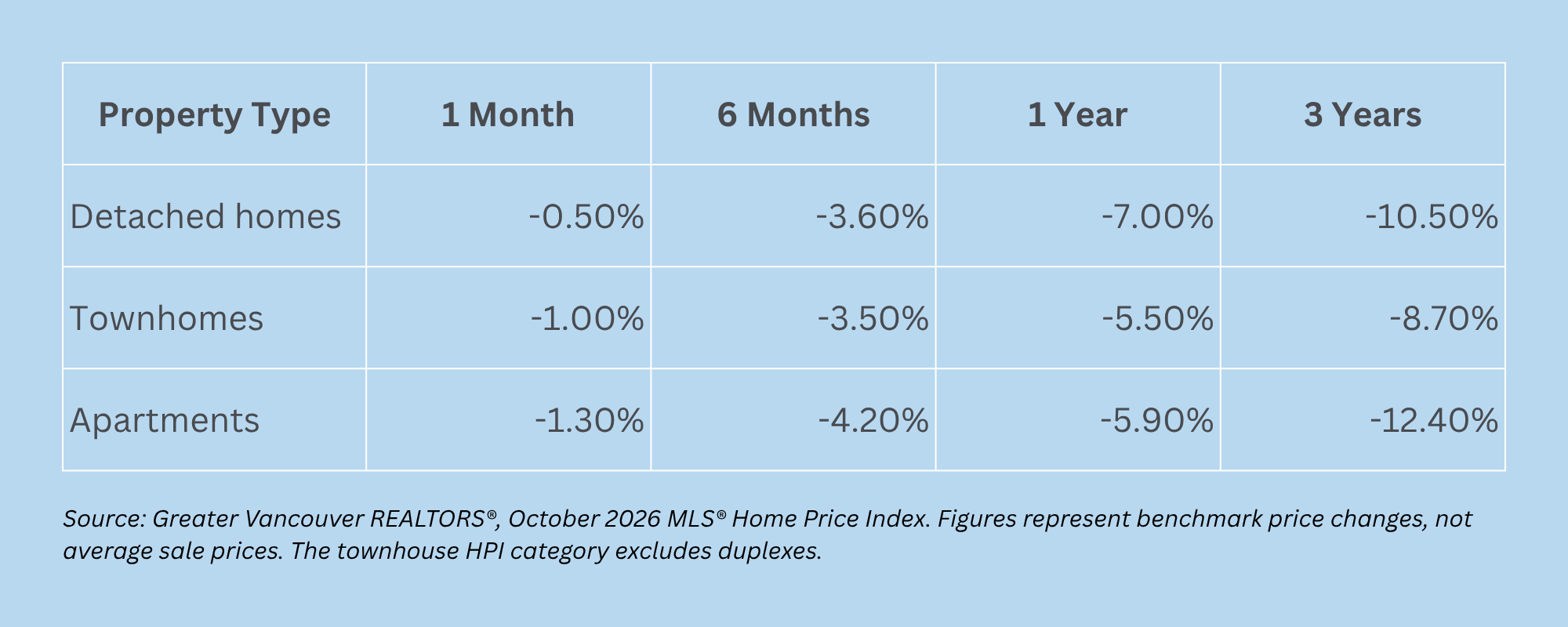
What stands out is that detached homes have experienced the largest decline over the past year, while apartments have experienced the largest decline over three years.
Townhomes have generally held up somewhat better over the three-year period, although they've certainly experienced their own correction.
These numbers are important because they give us perspective.
When we look at established neighbourhoods such as Main Street, Cambie Village and Fraser Street, we need to understand what's happening across the broader market before evaluating individual properties.
The Greater Vancouver figures don't tell us exactly how much a particular home on Main Street or Cambie has changed in value. However, they provide a useful reference point when reviewing recent comparable sales in these neighbourhoods.
And that's where local knowledge becomes particularly important.
Main Street Vancouver: More Than Just a Great Location
Main Street has become one of Vancouver's most recognizable and desirable communities, and for good reason.
From Mount Pleasant through Riley Park and down toward Main and 33rd Avenue, the neighbourhood offers a fantastic combination of character homes, newer duplexes, townhomes, condominiums, and established residential streets.
What makes Main Street particularly attractive is the lifestyle.
You can walk to your favourite coffee shop, grab groceries, visit independent restaurants, enjoy local shopping or head to one of the many nearby parks.
The neighbourhood has a strong community feel, with local businesses and amenities that have helped establish Main Street as a destination within Vancouver.
For families, access to schools, parks and community facilities is a major benefit. For professionals, convenient commuting and cycling routes make everyday life easier. For downsizers, the ability to walk to restaurants, shops and services can be just as important as the home itself.
Main Street real estate isn't simply about buying a property. It's about buying into an established community and a lifestyle that people genuinely enjoy.
And while property values can fluctuate, these neighbourhood characteristics don't disappear when the market slows.
Cambie Village: Established Homes, New Development and Excellent Transit
Cambie Village offers many of the same advantages as Main Street, with its own distinct character.
The area combines beautiful residential streets, local businesses, restaurants, parks and some of Vancouver's most convenient transportation connections.
The Canada Line provides excellent access to downtown Vancouver, Richmond and Vancouver International Airport, while nearby Broadway offers major employment centres, medical services and shopping.
Further south, Queen Elizabeth Park, Hillcrest Community Centre and the surrounding recreational facilities provide fantastic opportunities for outdoor activities and healthy living.
One thing I particularly appreciate about the Cambie area is the balance between urban convenience and quieter residential living.
From established detached homes to newer townhomes, duplexes, and condominium developments, Cambie offers several different options depending on budget and lifestyle.
The broader Cambie Corridor has also experienced considerable redevelopment, creating more housing choices while changing the character of certain streets.
For buyers, this means looking carefully at the differences between established properties and newer developments, including layout, construction quality, strata costs, and location.
A property in Cambie Village and a newer condo elsewhere along the Cambie Corridor can represent very different real estate opportunities.
Understanding those differences is essential when comparing value.
Why Location Matters During a Real Estate Market Correction
With Greater Vancouver detached homes down 7% over the past year and apartments down 5.9%, it's reasonable to ask whether certain neighbourhoods are better positioned to maintain their appeal.
I believe the answer comes down to more than simply looking at market statistics.
When buyers have more properties to choose from, they tend to become increasingly selective about location, layout, condition and the lifestyle a home offers.
Established neighbourhoods like Main Street, Cambie Village and Fraser Street benefit from amenities that have developed over decades.
Local restaurants, independent businesses, mature trees, schools, parks, cycling routes and convenient transit all contribute to their desirability.
These are qualities that can't easily be recreated in newer communities.
Having recently sold three properties around Fraser Street, I've seen firsthand how much buyers appreciate the combination of established residential streets and convenient neighbourhood amenities.
Of course, that doesn't mean every property in these areas will hold its value better than the broader market.
A dated condo, a poorly designed townhouse or a detached home on a busy street can still face challenges, regardless of the neighbourhood.
The key is understanding the individual property and how it compares with similar homes that have recently sold.
That's particularly important in a changing market, where pricing differences between properties can become more noticeable.
What Makes Main Street and Cambie Village Different?
One of the biggest advantages of these neighbourhoods is the combination of established housing, local amenities, and central Vancouver locations.
But another important consideration: the housing stock itself.
Many detached homes around Main Street, Riley Park, and Cambie sit on established residential lots, while newer duplex and multiplex developments are gradually changing the available housing options.
For buyers, this creates opportunities at different price points, but it also means properties need to be evaluated carefully.
An older detached home with renovation potential is a very different purchase from a newly completed duplex or a strata townhouse.
Land value, construction quality, outdoor space, parking, maintenance, and future renovation costs can all influence what a buyer is prepared to pay.
This is why I prefer to look closely at individual comparable sales rather than making broad assumptions about an entire neighbourhood.
A good location is an advantage, but buying the right property at the right price is what ultimately matters.
The Broadway Subway: A Major Investment in Vancouver's Future
Another important consideration for Main Street, Cambie Village and Mount Pleasant real estate is the Broadway Subway Project.
The Millennium Line extension will connect VCC–Clark Station to Arbutus Street, adding six underground stations along one of Vancouver's busiest transportation corridors.
The project is currently scheduled to open in fall 2027.
For residents around Main Street and Broadway, the new Mount Pleasant Station will provide improved access to rapid transit.
At Cambie and Broadway, the expanded Broadway–City Hall Station will connect the Millennium Line with the existing Canada Line, making travel across Vancouver and the surrounding region more convenient.
This infrastructure investment will improve connections to employment centres, hospitals, educational institutions and other important destinations.
Of course, a new SkyTrain station doesn't automatically mean property values will increase.
However, convenient public transportation is an important feature for many homebuyers, and improved connectivity adds to the long-term appeal of these established neighbourhoods.
Buying in Main Street or Cambie Village in 2026
For buyers, the current market presents opportunities that were much harder to find during the more competitive years.
There is generally more inventory to choose from, more time to complete due diligence, and greater opportunity to negotiate.
But not every listing represents good value.
A detached home that's priced 10% below what a similar property sold for three years ago might look attractive, but we still need to consider its condition, location, and the most recent comparable sales.
The same applies to condos and townhomes.
Even a few blocks can make a meaningful difference in value.
A quiet residential street, south-facing outdoor space, proximity to a park, or a convenient walk to shops and transit can all influence buyer demand.
For buyers planning to stay in their homes for the long term, I believe the focus should be on purchasing the right property, in the right location, at a price that makes sense in today's market.
Selling in Main Street or Cambie Village in 2026
For sellers, the strategy has changed.
We can no longer rely on the strong market conditions of previous years to generate multiple offers or push prices higher.
Buyers are doing their homework, comparing properties carefully and becoming more selective.
This makes accurate pricing, presentation and marketing particularly important.
A desirable neighbourhood is certainly an advantage, but it doesn't replace the need for a realistic pricing strategy.
I've been advising sellers to pay close attention to recent comparable sales and current competition rather than relying on older market highs.
With Greater Vancouver benchmark prices down across all three major property types, understanding how your home compares with the current competition is essential.
A well-presented home in a great location can still attract strong interest, even in a slower market.
Looking Ahead: Why I Remain Positive About Main Street and Cambie Village
I believe Vancouver's real estate market may continue to face challenges as we move toward the end of 2026 and into 2027.
Economic uncertainty, affordability, mortgage rates, and buyer confidence will continue to influence the market.
However, I remain positive about the long-term desirability of Main Street, Cambie Village and the surrounding central Vancouver communities.
These are neighbourhoods where people want to live, raise families, walk to local businesses, enjoy parks and feel connected to their community.
The continued investment in transportation, combined with established amenities and convenient locations, adds to their long-term appeal.
We may see further price adjustments, and buyers and sellers should remain realistic about market conditions.
But I believe well-located properties in established, walkable Vancouver neighbourhoods will continue to have strong appeal over the years ahead.
Real estate markets move through cycles. Great neighbourhoods remain great places to live.
Thinking About Buying or Selling in Vancouver?
I'm Matt Henry with RE/MAX Select Realty. Our office is located at Main Street and 32nd Avenue, and I live in the Lower Cambie area.
Richard Harrison and I work extensively throughout Main Street, Cambie Village, Mount Pleasant, Riley Park, Fraser Street, and the surrounding Vancouver communities.
Whether you're considering buying, selling, or simply want to understand what your property may be worth in today's market, we'd be happy to help.
We believe good real estate decisions start with understanding the market, the neighbourhood, and your long-term goals.










 The data relating to real estate on this website comes in part from the MLS® Reciprocity program of either the Real Estate Board of Greater Vancouver (REBGV), the Fraser Valley Real Estate Board (FVREB) or the Chilliwack and District Real Estate Board (CADREB). Real estate listings held by participating real estate firms are marked with the MLS® logo and detailed information about the listing includes the name of the listing agent. This representation is based in whole or part on data generated by either the REBGV, the FVREB or the CADREB which assumes no responsibility for its accuracy. The materials contained on this page may not be reproduced without the express written consent of either the REBGV, the FVREB or the CADREB.
 The data relating to real estate on this website comes in part from the MLS® Reciprocity program of either the Greater Vancouver REALTORS® (GVR), the Fraser Valley Real Estate Board (FVREB) or the Chilliwack and District Real Estate Board (CADREB). Real estate listings held by participating real estate firms are marked with the MLS® logo and detailed information about the listing includes the name of the listing agent. This representation is based in whole or part on data generated by either the GVR, the FVREB or the CADREB which assumes no responsibility for its accuracy. The materials contained on this page may not be reproduced without the express written consent of either the GVR, the FVREB or the CADREB.